

My grandfather never used computers, and he died when “wiki” was still just a word in Hawaiian. But in a single comment he taught me all about Enterprise 2.0.
Grandaddy (known to the rest of the world as Phil Plesofsky) was a mild-mannered, old-school stock broker with a boutique brokerage firm in Chicago. He wore pin-stripe suits so conservative that once he accidentally bought the same suit twice. His television idol was Fish, Abe Vigoda’s character on Barney Miller. When the office eventually installed computer terminals on all the brokers’ desks, Grandaddy tolerated his grudgingly, as if it were an uninvited relative who refused to leave but couldn’t be thrown out.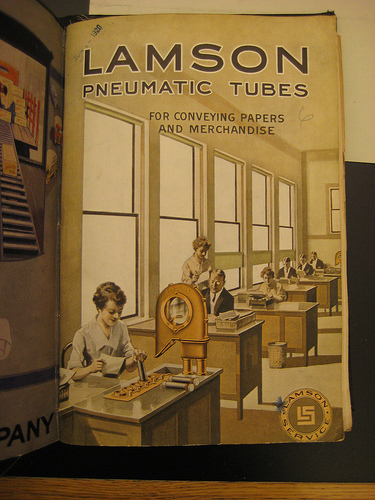
The firm, Freehling & Company, occupied one floor of a pre-war high-rise in the Loop. It was laid out as a single, open room with two long rows of desks where the brokers sat. A big board at the front of the room rolled stock prices as a tickertape noisily clacked out updates from the business news wire. Brokers submitted trades by sealing slips of paper in plastic cannisters, which were sucked through pneumatic tubes to the main office. (Photo courtesy of http://www.flickr.com/photos/molly/3077775845/).
One of the rituals of my childhood was visiting the Freehling office. Grandaddy would walk my brother and me down the brokerage floor, stopping at each desk to meet Irv, Norm, Jake, Stanley, and the other brokers (all men). They shook our hands, praised our grandfather, and told us how much we had grown since the last visit.
In the mid-80s, Freehling was acquired by a New York investment bank, who moved the offices to a brand new granite-and-steel high-rise on Lasalle. There was modern furniture and original art on the walls.
For the first time, the senior brokers had private offices.
When I visited the new office-a teenager by this time-I was impressed by the new offices. I complemented my grandfather on the big step up.
“To tell you the truth, I hate it,” he replied.
“Why?” I asked in disbelief.
“In the old place, when a broker got a tip about an upcoming earnings announcement or a CEO departure, we all knew about it instantly. You could actually watch the information roll across the floor like a wave, going from one desk to the next, to the next until everyone in the office was talking about it. Now we sit in our private offices, we close our doors, and nobody has the slightest idea what’s going on.”
That remains the best description of Enterprise 1.0 I have ever heard-which is why I still remember the comment over 20 years later.
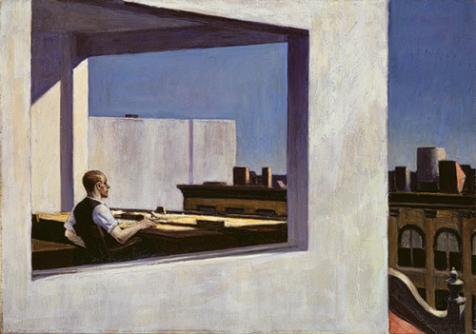 Many of us today sit in the digital equivalent of Grandaddy’s shiny, new, and very private office. We have powerful computers with big shiny screens and powerful tools for managing documents and sending messages. We have BlackBerries and iPhones. And in one respect, we’re more connected than ever before.
But there’s something missing. It’s all private. Sure we can email each other. Occasionally we even take the bold step of picking up a phone. But there’s no ambient awareness. There’s no serendipitous discovery of what a colleague is doing. There’s no wave of information that rolls instantly down the shop floor.
Enterprise 2.0 is all about leaving the private office and returning to that big, open space with the wave of information rolling from one desk to the next to the next)


 Tweet this



 Join our Google+ Circle
 Subscribe to our blog
 Subscribe to our newsletter
 Watch us on YouTube