

While wide awake at 4am the other night, I found myself reading Twitter status updates. People were discussing the presidential election, conference that were going on, sports, etc. I was consuming vast amounts of information.
However, it got me thinking… “There is something wrong when I know more about what is going on with “web folks”, than I do about many of my family and friends.”
Technically the answer lies in how easily accessible information is via the web, which people I’ve chosen to follow, who I add to my social networks, the blogs I read, etc.
But there is more to it. What defines a friend? An acquaintance? A colleague? Where does family fit in? Has technology helped me connect to people, or provided me distractions which keep me further away from those I should be spending the most time with?
Some facts:
- Almost none of my “closest” friends on are Twitter
- Zero family members are on Twitter (except my mom, whom I set up an account for, so she can keep up with me)
- Many of my friends, and even some of my family are on Facebook
- None of my best friends or family blog. However, many family members read my blog to keep up with what I’m doing.
As the “people-centric” nature of work becomes equally as important as the “content-centric” aspect, I think this very important to think about. Who is important to helping you get your job done. How do you know them, and how can you discover the people you should know?
I started coming up with a rating scale for how close I am to people. The list below is just brain storming. At best it is a rough guide. It is not very accurate, as I can easily think of exceptions to each category, and reasons to move each category up or down.

Complete strangers
I’m sorry, I’ve never heard of you.

They “know” you, but you don’t “know” them
This is quite common on the web, or in a job or position where you are a “public figure”.
This category feeds your ego. Everyone loves people to attend their sessions at events, read their blog, follow them on Twitter, etc. Anyone who says different is lying! 
These are the Facebook and Linked in invites from people who you have no clue about.

You “know” them, but they don’t “know” you
In contrast to the people above, here you are the follower. (just don’t be a stalker!)
These are the people you keep track of at some regular interval. You find them interesting, informative, or controversial enough that you want to know what they have to say, but you really don’t know them personally.
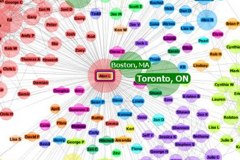
You interact with them on-line regularly, but are not “close”
This is your “social network”.
These are the people you try and take the time to keep up with, respond to their posts, comments on their photos, etc. However, a majority of these “on-line friends” are people I would not know if I passed on the street. That is not intended to be offensive, it is just reality.
There is also a portion in this group who is more important than others. Come on, do you really know all the people you’re connected with on Facebook, LinkedIn, Xing, etc, etc, etc, etc?

You’ve actually met in person
Obviously technology has enabled us to meet, interact, stay in touch with, and work with people around the world, across time zones, across borders, even across languages. The telephone, email, chat, web conferences, etc are all wonderful, but I always feel closer to someone once I’ve met them.
You’ve had a meal or drink together
Bonding with others over food and drink has always been a way to form relationships. Now the question is, does someone mean more to you if they pay, or if you pick up the tab?

You know details about them not found online
These are the friends whom you shared real experiences with. You’ve met their families, you’ve travelled together. You’ve stayed at their house. You look forward to seeing them at conferences. You miss them when you don’t see them for a long time.

People you interact with often in the real world
These are the people that touch your life, either at work or at play.

Friends and family that are closest to you
You have a long history together, from childhood, or school, or love.
You were at their graduation, wedding or other major event, and they will be at yours.
You answer the phone when you see their name on call waiting.
You’d hop on a plane to see them.
You’ve confided in them and value their advise, and vice versa.

You’d take a bullet for them
I’m not sure who exactly goes here, but it is some subset of the group above. Unless of course it is your job!

My Grandmother
Nuff said.

 Tweet this


 Join our Google+ Circle
 Subscribe to our blog
 Subscribe to our newsletter
 Watch us on YouTube