

Mom always told me, “It’s what’s inside that counts.”
Companies are finally paying attention to how social media affects their business outside the company walls. They recognize the extent to which Twitter, Facebook, Wikipedia, and other mass-collaboration forums present both opportunities and risks. There is excellent thought leadership on the topic, including Wikinomics, Groundswell, and Jeremiah Owyang’s blog, just to name a few.
Less well understood is the value of launching social software inside companies. Tapscott and Li/Bernoff each devote one chapter, late in their respective books, to “internal wikis” and the “internal groundswell”. External collaboration seems to be the main course for them, while internal is only dessert.
There are good reasons why super-smart people like Tapscott, Li, Bernoff, and Owyang focus disproportionately on external collaboration. First, external is sexier. External collaboration has far-reaching consequences for a company’s strategy, and even its business model. That’s heady stuff. Internal collaboration, by contrast, is all about working across silos and accelerating decision-making. Only org geeks like me get excited about that. Second, external collaboration has an obvious business owner-the Marketing Department-and therefore an easily identifiable market for books, speeches, and consulting services. The market for internal collaboration is more diverse. It can be IT, the CEO, the COO, HR, Corporate Communications, or no one at all.
But let’s think about that. If your Marketing department is driving collaboration and the rest of the company isn’t participating, then all you’re getting out of social media is marketing. Marketing is a nice thing, but companies social media generates much more value when companies engage on a deeper level. You want your Product people to have conversations directly with the people who use their products. You want your Support people to talk directly to the people they’re supporting. You want your Salespeople talking directly to their prospects. It’s not just about marketing, it’s about mobilizing your company to interact continuously with the individuals who drive your company’s performance.
As the CEO of a marketing agency put it to me, “How can we collaborate with our customers when we can’t collaborate with each other?”
Collaboration requires a huge cultural and operational change for most companies, and a steep learning curve for most employees. They have to overcome their fear of transparency, learn new tools, master new lingo and communications conventions, internalize new ways of working, and change their daily routines.
It ain’t gonna happen by following Ashton Kutcher on Twitter. If you want your employees to embrace social media, you need them to learn how to use social media for real work. Professional and personal interactions follow completely different norms and patterns.
The best place for your employees to learn professional social media is inside the company. Thomas Vanderwal was right when he told me that social media adoption is all about comfort. Most employees are intimidated by the openness and transparency of social media. By launching these tools internally-within teams, departments, divisions, business units, etc.-you acculturate your employees in controlled, comfortable environments. You can train them, educate them, watch them, and even (horrors!) let them make a few mistakes. Once your employees get used to using social software inside the company, it’s easy and natural for them to expand their interactions to include customers, channel partners, and even the general public.
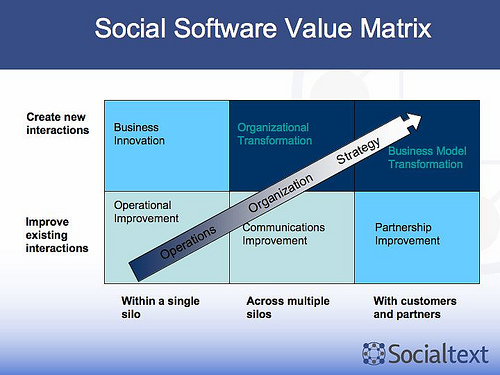
I think of Enterprise 2.0 adoption as a journey through a succession of benefits. I’ve illustrated them in what I call the “Social Software Value Matrix.” The first step in the journey is pure operational improvement. You’re not really changing the way you do business, just enhancing existing interactions within existing silos. Over time, the tools lead employees to interact in new ways, across silos. This creates cultural change as the company reinvents the way the different pieces of the business interact to create value. Finally, and most dramatically, companies can create new interactions with customers and channel partners. That’s business model transformation, and it only happens when your business is ready for it.
The good news is that there are benefits to your company all along the journey. By collaborating more effectively internally, your company will achieve better operations, faster decision-making, enhanced innovation, and accelerated cycle-times. Getting there is indeed half the fun.
And once again, Mom was right.


 We have already “signaled” your post to the masses…thanks for posting!




 Follow us on Twitter
 Follow us on Facebook
 Join our Google+ Circle
 Subscribe to our blog
 Subscribe to our newsletter
 Watch us on YouTube